
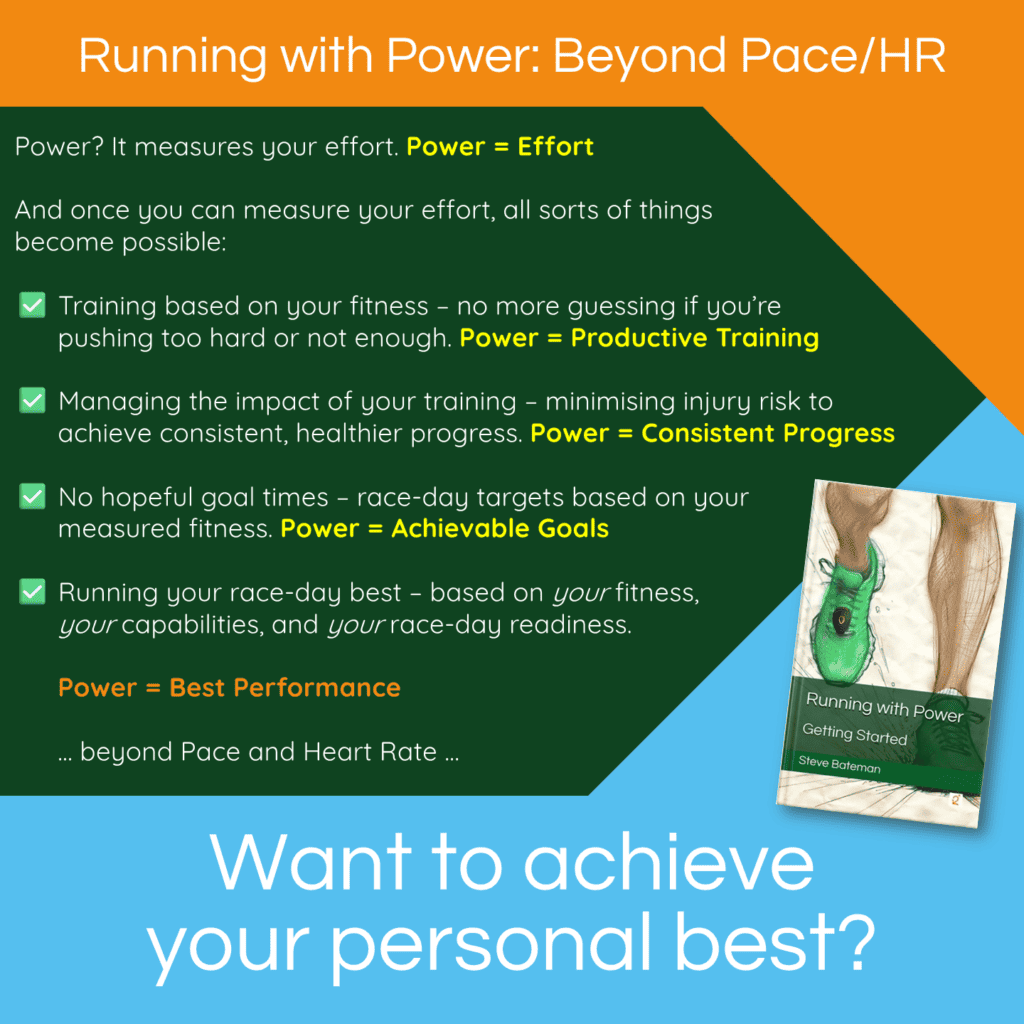
To celebrate the upcoming release of the Spanish version of ‘Getting Started’, I’m planning to update the cover of the English version too. This text (on the green background) will be on the back cover of the books (in the appropriate language) and in the book blurb on reseller websites.
This week, I’m posting about each of the ‘Power =’ items 🙂
𝐏𝐨𝐰𝐞𝐫 = 𝐀𝐜𝐡𝐢𝐞𝐯𝐚𝐛𝐥𝐞 𝐆𝐨𝐚𝐥𝐬
If you’re like I was (before power), you focus on goal times: “I’d love to break 1 hour for the 10k”, or “… 2 hours for a half”.
You may have used online calculators to put in a recent 5k or 10k time to check if your goal was realistic. Or you may have run specific workouts to confirm you could achieve your target time – Yasso 800s for example.
And then when you ran the event, you struggled to achieve your goal time … because it was more ‘hopeful’ than a prediction, based on running shorter distances then comparing the result against data averaged across thousands of runners, many of whom are nothing like you.
Wouldn’t it make more sense to use your completed workouts to set your event targets?
𝐏𝐨𝐰𝐞𝐫 𝐭𝐚𝐫𝐠𝐞𝐭𝐬
When running with power, event targets are based on:
✅ your current running fitness (or Threshold)
✅ your measured fatigue resistance / stamina (which may differ depending on whether it’s a 5k or a marathon)
✅ your proven ability to convert effort into forward motion (your Running Effectiveness)
All these metrics are based on your completed workouts and are individual to you.
And when used to calculate race targets, the result is a power number (or range) you should be able to maintain for the entire event.
𝐍𝐨 𝐦𝐨𝐫𝐞 ‘𝐡𝐨𝐩𝐞𝐟𝐮𝐥’ 𝐠𝐨𝐚𝐥 𝐭𝐢𝐦𝐞𝐬
There are a few key differences though:
⚡ The targets are power targets. They’re not a goal time. This takes a little getting used to.
🏃🏼♂️ The targets apply to the entire event: To the start (so you don’t go out too fast); To the hills (so you can run them without ‘over-cooking’ yourself); To the finish (so you can finish strong).
⏱️ The calculators can provide an estimated finish time, but this is an estimation. Instead, run to power targets … and let the time take care of itself.
𝐀𝐜𝐡𝐢𝐞𝐯𝐚𝐛𝐥𝐞 𝐆𝐨𝐚𝐥𝐬?
Power targets represent the best you can achieve on the day, based on your fitness, your capabilities and your race-day readiness.
And for many runners, they’ve resulted in new Personal Bests (PBs) … myself included.
𝑺𝒉𝒐𝒖𝒍𝒅𝒏’𝒕 𝒚𝒐𝒖 𝒃𝒆 𝑹𝒖𝒏𝒏𝒊𝒏𝒈 𝒘𝒊𝒕𝒉 𝑷𝒐𝒘𝒆𝒓?
Getting Started – Power=Achievable Goals