
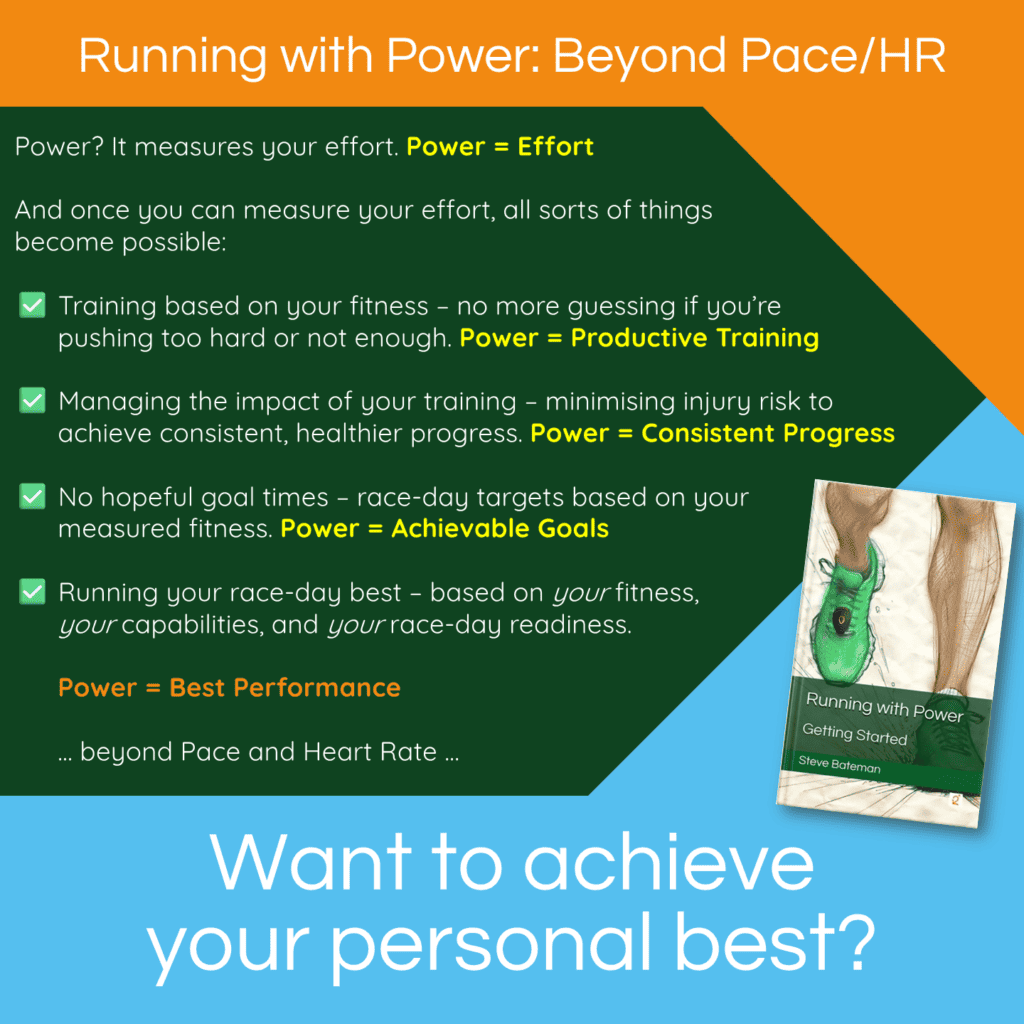
To celebrate the release of the Spanish version of ‘Getting Started’, I’m planning to update the cover of the English version too. The text above (on the green background) will be on the back cover of the books (in the appropriate language) and in the book blurb on reseller websites.
𝐏𝐨𝐰𝐞𝐫 = 𝐄𝐟𝐟𝐨𝐫𝐭
Power measures how hard you’re running – it’s a measure of intensity, like pace, heart rate (HR), or perceived effort.
But it’s measuring something different from pace, which measures how fast you’re running, or HR, which measures how hard your heart is working.
It’s most like perceived effort.
⚡ Power measures how hard you’re working when you run – your effort.
𝐒𝐨 𝐢𝐭’𝐬 𝐣𝐮𝐬𝐭 𝐚𝐧𝐨𝐭𝐡𝐞𝐫 𝐰𝐚𝐲 𝐭𝐨 𝐦𝐞𝐚𝐬𝐮𝐫𝐞 𝐡𝐨𝐰 𝐡𝐚𝐫𝐝 𝐲𝐨𝐮’𝐫𝐞 𝐫𝐮𝐧𝐧𝐢𝐧𝐠?
Yes.
But it’s not “just another way”.
❌ Unlike HR, power numbers don’t ‘lag’ when you run harder or run easier; they don’t ‘drift’ so that you end up almost walking to “stay in Zone 2” on a long run; and there’s no maximum that limits the numbers.
❌ Unlike pace, you don’t need to ‘grade adjust’ when running hills; and there’s no temptation to aim for a ‘hopeful goal time’ that you may or may not be able to achieve.
❌ Unlike perceived effort, you’re working with numbers rather than ‘feelings’; and you can work with those numbers from day 1, rather than spending years to develop your feel.
⚡ Power provides numbers that, second-by-second, measure your effort.
𝐈𝐬 𝐢𝐭 𝐫𝐞𝐚𝐥𝐥𝐲 𝐦𝐞𝐚𝐬𝐮𝐫𝐢𝐧𝐠 𝐲𝐨𝐮𝐫 𝐞𝐟𝐟𝐨𝐫𝐭?
No.
It’s using lots of different sensors to calculate numbers that represent your effort.
But as long as those numbers are repeatable and valid …
✅ repeatable: same effort + same conditions = same power
✅ valid: they produce similar results as a ‘gold standard’ like oxygen consumption
… they represent your effort.
⚡ Power makes your effort measurable.
And once you can measure your effort, all sorts of things become possible.
𝑺𝒉𝒐𝒖𝒍𝒅𝒏’𝒕 𝒚𝒐𝒖 𝒃𝒆 𝑹𝒖𝒏𝒏𝒊𝒏𝒈 𝒘𝒊𝒕𝒉 𝑷𝒐𝒘𝒆𝒓?