
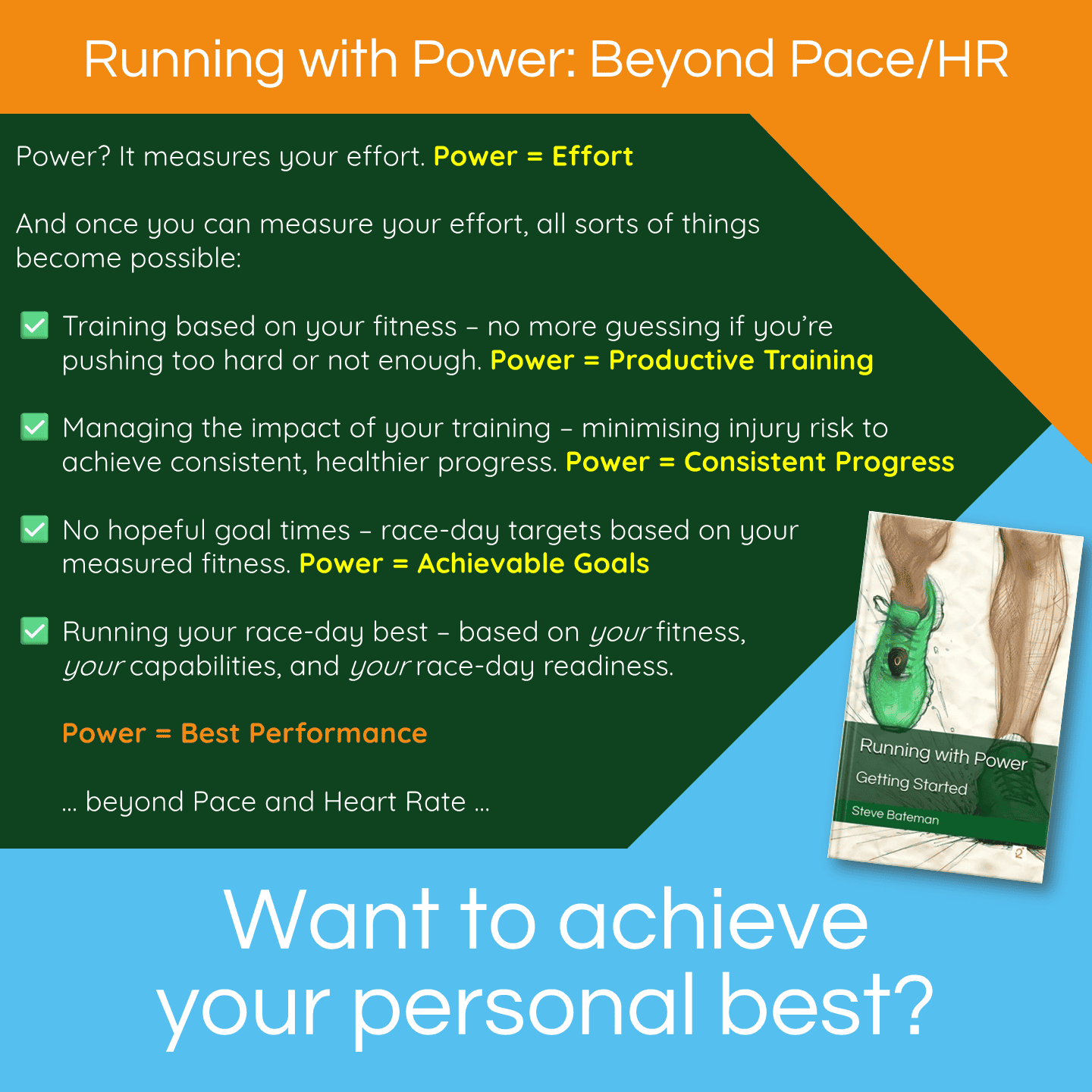
Power = Effort
To celebrate the upcoming release of the Spanish version of ‘Getting Started’, I’m planning to update the cover of the English version too. This text (on the green background) will be on the back cover of the books (in the appropriate language) and in the book blurb on reseller websites.
This week, I’m posting about each of the ‘Power =’ items 🙂
Power = Effort
Power measures how hard you’re running – it’s a measure of intensity, like pace, heart rate (HR), or perceived effort.
But it’s measuring something different from pace, which measures how fast you’re running, or HR, which measures how hard your heart is working.
It’s most like perceived effort.
⚡ Power measures how hard you’re working when you run – your effort.
So it’s just another way to measure how hard you’re running?
Yes.
But it’s not ‘just another way’.
❌ Unlike HR, power numbers don’t ‘lag’ when you run harder or run easier; they don’t ‘drift’ so that you end up almost walking to stay in Zone 2 on a long run; and there’s no maximum that limits the numbers.
❌ Unlike pace, you don’t need to ‘grade adjust’ when running hills; and there’s no temptation to aim for a ‘hopeful goal time’ that you may or may not be able to achieve.
❌ Unlike perceived effort, you’re working with numbers rather than ‘feelings’; and you can work with those numbers from day 1, rather than spending years to develop your feel.
⚡ Power provides numbers that, second-by-second, measure your effort.
Is it really measuring your effort?
No.
It’s using lots of different sensors to calculate numbers that represent your effort.
But as long as those numbers are repeatable and valid …
✅ repeatable: same effort + same conditions = same power
✅ valid: they produce similar results as a ‘gold standard’ like oxygen consumption
… they represent your effort.
⚡ Power makes your effort measurable.
And once you can measure your effort, all sorts of things become possible.
Topic: The Getting Started book cover
Verified for accuracy: