Getting Started – What makes this book different?

Man with pen researching a book

𝐆𝐞𝐭𝐭𝐢𝐧𝐠 𝐒𝐭𝐚𝐫𝐭𝐞𝐝 – 𝐖𝐡𝐚𝐭 𝐦𝐚𝐤𝐞𝐬 𝐭𝐡𝐢𝐬 𝐛𝐨𝐨𝐤 𝐝𝐢𝐟𝐟𝐞𝐫𝐞𝐧𝐭?

I’ve written three books that cover running with power.

  1. The Basics. A reference for the world of running with power, and heavily focused on power concepts and metrics. The book covers equipment and apps, but not from the perspective of getting started.
  2. Why would you? This book explains why you might use power, as well as its differences and potential disadvantages. It’s for runners who are deciding whether to try using power.
  3. Getting Started. Written specifically for runners who’ve decided to try using power, this is a hands-on guide that walks you through the things you need to begin your journey.

𝐖𝐡𝐚𝐭 𝐦𝐚𝐤𝐞𝐬 ‘𝐆𝐞𝐭𝐭𝐢𝐧𝐠 𝐒𝐭𝐚𝐫𝐭𝐞𝐝’ 𝐝𝐢𝐟𝐟𝐞𝐫𝐞𝐧𝐭?

The key differences:
✅ It covers the Stryd footpod and wrist-based power – wrist-based power is a recent development, and one that may be more budget-friendly for many runners.
✅ A heavy focus on choosing equipment & apps – so that you can make the right choices from the start, avoiding expensive or frustrating mistakes.
✅ Coverage of five fundamental power concepts – so that you have a solid foundation on which to continue building your knowledge and use of power, without getting stuck in too much detail or nuance. And the activities help translate the learning into practice.

… finally, with my third book, there are some things I’ve learned from the previous two that make this book more accessible to readers.

𝑺𝒉𝒐𝒖𝒍𝒅𝒏’𝒕 𝒚𝒐𝒖 𝒃𝒆 𝑹𝒖𝒏𝒏𝒊𝒏𝒈 𝒘𝒊𝒕𝒉 𝑷𝒐𝒘𝒆𝒓?

Questions?
📖 Getting Started

What makes this book different?

Getting Started – Team contributions

Man with pen researching a book

𝐆𝐞𝐭𝐭𝐢𝐧𝐠 𝐒𝐭𝐚𝐫𝐭𝐞𝐝 – 𝐓𝐞𝐚𝐦 𝐜𝐨𝐧𝐭𝐫𝐢𝐛𝐮𝐭𝐢𝐨𝐧𝐬

The book wouldn’t be the book it is without contributions and feedback from the testing team – some major, some less so.

𝐂𝐡𝐚𝐧𝐠𝐞𝐬 𝐛𝐚𝐬𝐞𝐝 𝐨𝐧 𝐟𝐞𝐞𝐝𝐛𝐚𝐜𝐤 𝐟𝐫𝐨𝐦 𝐭𝐡𝐞 𝐭𝐞𝐬𝐭𝐢𝐧𝐠 𝐭𝐞𝐚𝐦

Here are some major changes:
👏🏼 I re-wrote Chapter 10 ‘Power-Duration’ from the point of view of fatigue, which makes much more sense than the previous explanation.
👏🏼 Added Chapter 6 ‘Example combinations’ to show equipment and app combinations (with diagrams) proven to work well together.
👏🏼 Moved Part 3 ‘Setups and Configs’ and some of Part 1 online, as power equipment & apps are still developing rapidly.

And some not so major, but just as important:
👏🏼 Added runner ages (to the nearest decade) to the runner stories – power works no matter your age
👏🏼 Added ‘key takeaway’ items throughout
👏🏼 Removed ‘try it yourself’ phrase when referring to activities
👏🏼 Added emphasis on why it’s critical to include enough recovery (‘magic time’) in your training schedule

𝐑𝐞𝐟𝐥𝐞𝐜𝐭𝐢𝐨𝐧𝐬 𝐨𝐧 𝐢𝐧𝐯𝐨𝐥𝐯𝐢𝐧𝐠 𝐚 𝐭𝐞𝐬𝐭𝐢𝐧𝐠 𝐭𝐞𝐚𝐦

I’m so glad I worked with a testing team. The team acted as editors and as an early book audience, feeding back where things weren’t as clear as they could be, especially for readers with English as a second language.

I’m indebted to my testing team – and would use the same approach for any future ‘practical’ books!

𝑺𝒉𝒐𝒖𝒍𝒅𝒏’𝒕 𝒚𝒐𝒖 𝒃𝒆 𝑹𝒖𝒏𝒏𝒊𝒏𝒈 𝒘𝒊𝒕𝒉 𝑷𝒐𝒘𝒆𝒓?

Questions?
📖 Getting Started

Getting Started – The testing team

Man with pen researching a book

𝐆𝐞𝐭𝐭𝐢𝐧𝐠 𝐒𝐭𝐚𝐫𝐭𝐞𝐝 – 𝐓𝐡𝐞 𝐭𝐞𝐬𝐭𝐢𝐧𝐠 𝐭𝐞𝐚𝐦

With the goal and structure in place, I realised I was going to need help, for a few different reasons:
🔸 I’ve been using power since 2018, but the audience would be new to power
🔸 I run road races; trail runners and track athletes can also use power
🔸 I use a Garmin with a Stryd – what about wrist-based power or other watches?
🔸 I wanted a good mix of runners and coaches, watches, and experience

𝐓𝐡𝐞 𝐭𝐞𝐚𝐦

I asked for volunteers, with the promise of a copy of the book for those able to contribute.

The response was fantastic, 35 people volunteering. After video-calling 20 of the volunteers, 13 made it onto the testing team.

𝐃𝐞𝐦𝐨𝐠𝐫𝐚𝐩𝐡𝐢𝐜𝐬

The testing team included:
✅ 2 people who’d never used power before
✅ 6 Garmin users, 4 Apple Watch, 1 each using COROS, Suunto and Polar
✅ 2 using wrist-based power
✅ 7 road-runners, 1 track, 2 triathlon, 3 trail/triathlon
✅ 6 coaches

I couldn’t have hoped for a better cross-section 😊

𝐅𝐢𝐫𝐬𝐭 𝐨𝐫𝐝𝐞𝐫 𝐨𝐟 𝐛𝐮𝐬𝐢𝐧𝐞𝐬𝐬

The video call outlined the book and book goals, coverage of the five fundamental power concepts, and 22 ideas for activities that runners could use to try out power.

Using an outline of each activity, the testing team tried them out and made suggestions … eventually we merged and rearranged the original 22 ideas, landing on 13, and moved on to the rest of the book.

𝑺𝒉𝒐𝒖𝒍𝒅𝒏’𝒕 𝒚𝒐𝒖 𝒃𝒆 𝑹𝒖𝒏𝒏𝒊𝒏𝒈 𝒘𝒊𝒕𝒉 𝑷𝒐𝒘𝒆𝒓?

Questions?
📖 Getting Started

Getting Started – The story behind the book

Man with pen researching a book

𝐆𝐞𝐭𝐭𝐢𝐧𝐠 𝐒𝐭𝐚𝐫𝐭𝐞𝐝 – 𝐭𝐡𝐞 𝐬𝐭𝐨𝐫𝐲 𝐛𝐞𝐡𝐢𝐧𝐝 𝐭𝐡𝐞 𝐛𝐨𝐨𝐤

‘Getting Started’ is my third book. It’s the book I most enjoyed writing.

After ‘The Basics’ and ‘Why would you?’ I thought I was done.

But then I started to explore wrist-based power and realised that runners who wanted to try Running with Power using the power meter built into their running watch had little or no guidance about how to do that.

𝐁𝐨𝐨𝐤 𝐠𝐨𝐚𝐥𝐬

I was aiming to meet the following goals:
✅ No assumption of a particular power meter
✅ Lots of advice on making the right equipment and app choices
✅ Just enough conceptual content to provide a solid foundation
✅ A learning by doing approach to support the concepts and to start using power
✅ Minimal overlap with the existing books

𝐁𝐨𝐨𝐤 𝐨𝐮𝐭𝐥𝐢𝐧𝐞

With the above goals, a three-part structure seemed to be the best approach:

  1. Equipment & Apps. Information about options, and how to combine those to end up with something that worked.
  2. Fundamental Concepts. The key concepts underlying Running with Power, to provide a solid foundation for future learning and fine-tuning. This part would include activities that runners could use to try out the use of power.
  3. Setups & Configs. Because Running with Power is still relatively new, things don’t always work as smoothly as they ought to. This part would provide detailed setup and configuration information to make it easier to arrive at a working setup.

𝐍𝐞𝐱𝐭 𝐬𝐭𝐞𝐩𝐬

With the goal and structure in place, I realised I was going to need help …

𝑺𝒉𝒐𝒖𝒍𝒅𝒏’𝒕 𝒚𝒐𝒖 𝒃𝒆 𝑹𝒖𝒏𝒏𝒊𝒏𝒈 𝒘𝒊𝒕𝒉 𝑷𝒐𝒘𝒆𝒓?

Questions?
📖 Getting Started

The story behind the book

Races and Events – The event

Picture of runners waiting to start an event

𝐑𝐚𝐜𝐞𝐬 & 𝐄𝐯𝐞𝐧𝐭𝐬 – 𝐓𝐡𝐞 𝐞𝐯𝐞𝐧𝐭

Power can help you perform your personal best on the day.

How? By:
⚡ identifying a single target you can maintain throughout the event
⚡ helping you 𝑛𝑜𝑡 go out too fast
⚡ reducing anxiety associated with trying to achieve a goal time

𝐄𝐯𝐞𝐧𝐭 𝐭𝐚𝐫𝐠𝐞𝐭𝐬

Before the event, power race calculators use your current fitness, your fatigue resistance (or stamina) and how effectively you convert effort into forward motion to identify a race power target.

Some calculators also allow you to create scenarios, by varying your fatigue resistance or running effectiveness to show best case/worst case targets.

These calculations are based on you – your fitness, your capabilities.

Which means power targets are personal – they identify an effort level you can maintain throughout the event.

It also means that you can’t run with pacers, as they’ll be running to a pace target.

𝐃𝐨𝐧’𝐭 𝐠𝐨 𝐨𝐮𝐭 𝐭𝐨𝐨 𝐟𝐚𝐬𝐭

Your race power target also helps prevent you starting the event too fast – at too high an effort.

Which means you should have enough energy left to finish the event strong.

𝐑𝐞𝐝𝐮𝐜𝐞 𝐚𝐧𝐱𝐢𝐞𝐭𝐲

There’s nothing worse than running to a (hopeful) goal time, translating that into pace targets, then finding that you’re falling behind the pace.

And there’s nothing better than running to a power target that represents the effort you can maintain throughout the event … to achieve your personal best on the day.

𝑺𝒉𝒐𝒖𝒍𝒅𝒏’𝒕 𝒚𝒐𝒖 𝒃𝒆 𝑹𝒖𝒏𝒏𝒊𝒏𝒈 𝒘𝒊𝒕𝒉 𝑷𝒐𝒘𝒆𝒓?

Questions?
📖 Getting Started

Races & Events – The event

Races and Events – Ready, set, go!

Picture of runners waiting to start an event

𝐑𝐚𝐜𝐞𝐬 𝐚𝐧𝐝 𝐄𝐯𝐞𝐧𝐭𝐬 – 𝐑𝐞𝐚𝐝𝐲, 𝐬𝐞𝐭, 𝐠𝐨!

You’ve trained, you’ve tapered, and the event is just about here.

Using power, what’s important?
⌚ Your watch setup, so that you don’t get distracted during the event
🪫 Your equipment, so that it’s fully charged
⚡ Your warm-up, so that you’re primed for the event

𝐖𝐚𝐭𝐜𝐡 𝐬𝐞𝐭𝐮𝐩

I’ve arrived at a ‘less is more’ philosophy.

It took a few years, but gradually, I’ve come to trust power (and power metrics) and chosen the few metrics I want showing on my watch.

I’d recommend setting up your watch to:
✅ auto-lap every mile or kilometre (your preference) to reset lap average power
✅ show lap and 3s average power (or real-time power if 3s average isn’t an option)
✅ include last lap power if you have it, so that you don’t need to glance down every auto-lap

Resist the temptation to include elapsed time, time of day, pace or heart rate, as these may distract you from maintaining your power target.

𝐂𝐡𝐚𝐫𝐠𝐞 𝐲𝐨𝐮𝐫 𝐞𝐪𝐮𝐢𝐩𝐦𝐞𝐧𝐭

A simple reminder – to avoid flat batteries part-way through the event.

𝐖𝐚𝐫𝐦-𝐮𝐩 / 𝐩𝐫𝐢𝐦𝐢𝐧𝐠

Your warm-up should include mobilisation and dynamic stretching and 5-10 minutes of jogging – no different than if you were using pace or heart rate.

Then run some short intervals at just below Threshold Power, just above Threshold Power and finish with some strides or short sprints. This will prime your different energy systems – with power, you can ensure your intervals are at the correct intensities.

Ideally, prime the day before the event and during the 1-2 hours before your start time, so that you don’t start the event feeling sluggish.

𝑺𝒉𝒐𝒖𝒍𝒅𝒏’𝒕 𝒚𝒐𝒖 𝒃𝒆 𝑹𝒖𝒏𝒏𝒊𝒏𝒈 𝒘𝒊𝒕𝒉 𝑷𝒐𝒘𝒆𝒓?

Questions?
📖 Getting Started

Races & Events – Ready, set, go!

Races and Events – Tapering

Picture of runners waiting to start an event

𝐑𝐚𝐜𝐞𝐬 & 𝐄𝐯𝐞𝐧𝐭𝐬 – 𝐓𝐚𝐩𝐞𝐫𝐢𝐧𝐠

Tapering aims to achieve a controlled reduction in your training so that your body has time to recover from training fatigue without losing too much fitness.

It aims to deliver you to the start line with maximum fitness and ‘on fresh legs’.

It’s a balance. Start the taper too soon, and you’ll miss out on training; too late, you’ll arrive with tired or heavy legs.

𝐏𝐥𝐚𝐧𝐧𝐢𝐧𝐠 𝐲𝐨𝐮𝐫 𝐭𝐚𝐩𝐞𝐫

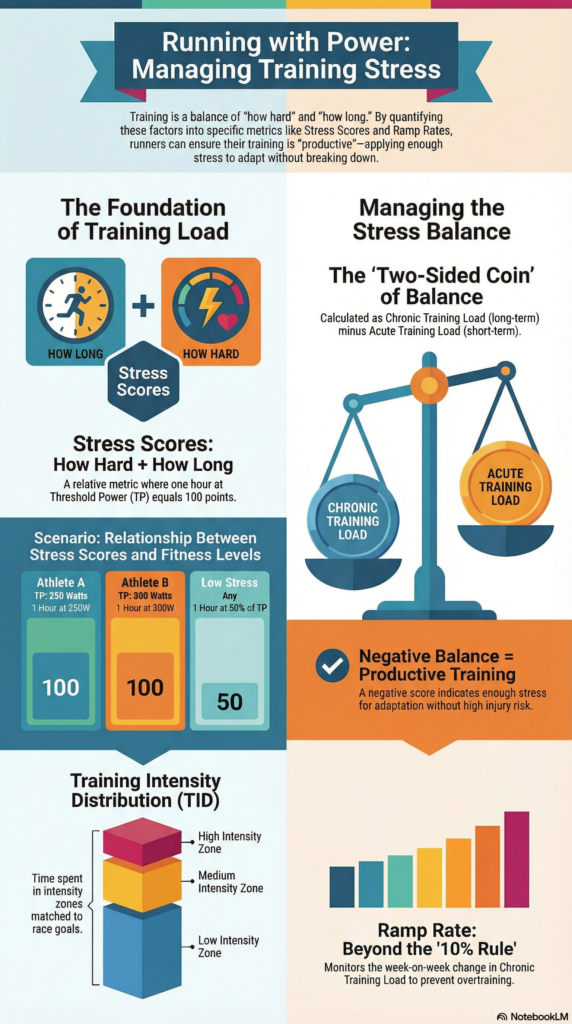
Tapering uses two metrics:
✅ Your Stress Balance. As you approach your event, you can plan your workouts so that your Stress Balance becomes more positive.
✅ Your Ramp Rate. As you approach your event, you can plan your workouts so that your Ramp Rate becomes less positive.

Both metrics use planned numbers based on your upcoming workouts to ‘look ahead’ at the numbers that will be in place on the event date.

𝐖𝐡𝐚𝐭 𝐬𝐡𝐨𝐮𝐥𝐝 𝐲𝐨𝐮 𝐮𝐬𝐞 𝐚𝐬 𝐭𝐚𝐫𝐠𝐞𝐭𝐬?

This depends on the event duration (shorter events usually need a shorter taper) and how the event factors into your longer-term plans:
🎯 If it’s the event you’ve been training for, you might aim for a positive training balance and a negative ramp rate, ‘giving up’ some training leading up to the event.
🎯 If it’s an event you’re using to test fitness or race-day strategy, you might aim for a training balance around zero but maintain a positive ramp rate, scaling back your training but not giving up too much.

There are many other things you should also consider when tapering, but using your training load metrics provides a solid foundation.

𝑺𝒉𝒐𝒖𝒍𝒅𝒏’𝒕 𝒚𝒐𝒖 𝒃𝒆 𝑹𝒖𝒏𝒏𝒊𝒏𝒈 𝒘𝒊𝒕𝒉 𝑷𝒐𝒘𝒆𝒓?

Questions?
📖 Getting Started

Races and Events – Race Targets

Picture of runners waiting to start an event

𝐑𝐚𝐜𝐞𝐬 & 𝐄𝐯𝐞𝐧𝐭𝐬 – 𝐑𝐚𝐜𝐞 𝐓𝐚𝐫𝐠𝐞𝐭𝐬

If you’re like I was (before power), your race target is a goal time: “I’d love to break 1 hour for the 10k”, or “… 2 hours for a half”.

You may have used online calculators to put in a 5k time (or an 800m time) to see what your equivalent 10k or half time would be.

And then when you ran the event, you struggled to achieve the predicted time … because it was more ‘hopeful’ than a prediction, based on using a single data point with data averaged across thousands of runners, many of whom are nothing like you.

𝐏𝐨𝐰𝐞𝐫 𝐭𝐚𝐫𝐠𝐞𝐭𝐬 𝐚𝐫𝐞 𝐝𝐢𝐟𝐟𝐞𝐫𝐞𝐧𝐭

Event targets when running with power are based on:
✅ your current running fitness
✅ your measured fatigue resistance (or stamina)
✅ your proven ability to convert effort into forward motion

All three (metrics) are based on your completed workouts and are individual to you.

𝐇𝐨𝐰 𝐚𝐫𝐞 𝐫𝐚𝐜𝐞 𝐭𝐚𝐫𝐠𝐞𝐭𝐬 𝐜𝐚𝐥𝐜𝐮𝐥𝐚𝐭𝐞𝐝?

If you use a Stryd footpod, you have access to the Stryd Race Power Calculator. The calculator will prompt you for the information needed for the calculation.

If you don’t use a Stryd footpod (or even if you do), you also have access to SuperPower Calculator for Sheets (SPCs). Steve Palladino has recorded several videos showing how to use SPCs to calculate race scenarios.

𝐍𝐨 𝐦𝐨𝐫𝐞 ‘𝐡𝐨𝐩𝐞𝐟𝐮𝐥’ 𝐠𝐨𝐚𝐥 𝐭𝐢𝐦𝐞𝐬

Race power targets represent the effort you should be able to maintain for the entire event. The calculators can also provide an estimated finish time, but this is an estimation – instead, run to effort … and let the time take care of itself.

𝑺𝒉𝒐𝒖𝒍𝒅𝒏’𝒕 𝒚𝒐𝒖 𝒃𝒆 𝑹𝒖𝒏𝒏𝒊𝒏𝒈 𝒘𝒊𝒕𝒉 𝑷𝒐𝒘𝒆𝒓?

Questions?
📖 Getting Started

More about the Race Calculators can be found at:
🔹 Stryd: Race Power Calculator in PowerCenter
🔹 SuperPower Calculator for Sheets (click to download a copy)
Steve Palladino’s videos are on YouTube

Races & Events – Race Targets

Races and Events – with Power

Picture of runners waiting to start an event

𝐑𝐚𝐜𝐞𝐬 & 𝐄𝐯𝐞𝐧𝐭𝐬 – 𝐰𝐢𝐭𝐡 𝐏𝐨𝐰𝐞𝐫

Races & Events are a little different when Running with Power.

The next few posts will dig into the detail, but in summary (and as a taster):
⚡ Your race-day power target is based on your fitness and capabilities
⚡ Tapering uses power-based metrics to determine when and how to taper
⚡ On the day, your target is your target for the entire event (no adjustments needed)
⚡ You won’t be able to (or need to) run with pacers
⚡ You’ll run to power, to achieve your personal best on the day

This is quite different than:
❌ looking up a hopeful goal time from a table compiled using data from thousands of runners (many of whom are nothing like you)
❌ tapering for a period and approach determined using general guidelines
❌ wearing a wrist band telling you your pace (per mile or kilometre) based on whether the section is uphill, downhill or flat
❌ going out too fast and suffering the consequences later in the event
❌ trying to keep up with pacers to achieve your hopeful goal time

It takes a little getting used to.

Especially the part about running to a power target rather than a (hopeful) goal time.

But this effort-based approach has been proven hundreds of times and has produced many unexpected personal bests.

𝑺𝒉𝒐𝒖𝒍𝒅𝒏’𝒕 𝒚𝒐𝒖 𝒃𝒆 𝑹𝒖𝒏𝒏𝒊𝒏𝒈 𝒘𝒊𝒕𝒉 𝑷𝒐𝒘𝒆𝒓?

Questions?
📖 Getting Started

Racing & Events – with Power

Power Apps – point solutions

Power apps - calculating metrics

𝐏𝐨𝐰𝐞𝐫 𝐀𝐩𝐩𝐬 – 𝐩𝐨𝐢𝐧𝐭 𝐬𝐨𝐥𝐮𝐭𝐢𝐨𝐧𝐬

Power is still relatively new for runners. And while there are some apps that cover most of the important metrics, you may find that you need additional apps to plug the gaps.

Here are a few apps that can fill those gaps.

𝐔𝐬𝐢𝐧𝐠 𝐀𝐩𝐩𝐥𝐞 𝐰𝐫𝐢𝐬𝐭-𝐛𝐚𝐬𝐞𝐝 𝐩𝐨𝐰𝐞𝐫

Apple Health doesn’t provide any of the important metrics.

Which means you’ll need to transfer your workout data from Apple Health into an app that can provide these, like WKO or Intervals.icu.

There are a few apps that will do this. I’ve successfully used HealthFit; other options are RunGap or Health Sync.

𝐑𝐮𝐧𝐧𝐢𝐧𝐠 𝐄𝐟𝐟𝐞𝐜𝐭𝐢𝐯𝐞𝐧𝐞𝐬𝐬 (𝐑𝐄)

The only app to provide this (natively) is WKO.

If you’re a Stryd user, or if you’re using Intervals.icu, you’ll need to calculate RE manually or use SuperPower Calculator for Sheets (SPCs).

Steve Palladino’s video ‘Running Effectiveness and the SuperPower Calculator’ demonstrates how to use SPCs to calculate RE for a workout or a workout section.

𝐎𝐭𝐡𝐞𝐫 𝐚𝐩𝐩𝐬

‘Getting Started’ covers other apps that can calculate power metrics, while the book’s online content provides a more complete comparison of Power Apps.

𝑺𝒉𝒐𝒖𝒍𝒅𝒏’𝒕 𝒚𝒐𝒖 𝒃𝒆 𝑹𝒖𝒏𝒏𝒊𝒏𝒈 𝒘𝒊𝒕𝒉 𝑷𝒐𝒘𝒆𝒓?

Questions?
📖 Getting Started

point solutions