

You fatigue faster at higher intensities
Intuitively, this is obvious.
If you sprint, you can’t sprint for a long time, and the faster you run, the shorter the time you can keep it going.
What’s not obvious is that there is a mathematical relationship between your intensity (your effort) and how long you can maintain it.
The research
Monod and Scherrer’s research into single muscle groups showed that the fast component of fatigue follows a hyperbolic curve.
This research identified the bottom of the curve (the asymptote) as ‘an exercise intensity that could be sustained for a very long time’, naming it Critical Power (CP).
The research also identified that the curve’s hyperbolic shape makes it ‘possible to define the maximum amount of work that can be performed in a given time, as well as the conditions of work performed without fatigue.’
They called this maximum amount of work W’. Anaerobic Work Capacity (AWC) and Reserve Work Capacity (RWC) are other names for W’; Functional Reserve Capacity (FRC) describes a similar concept with a different calculation method (but still hyperbolic).
Further research by Hill extended and validated these concepts for whole-body exercise, noting that ‘for a very long time’ was usually 30 to 60 minutes of exercise at CP.
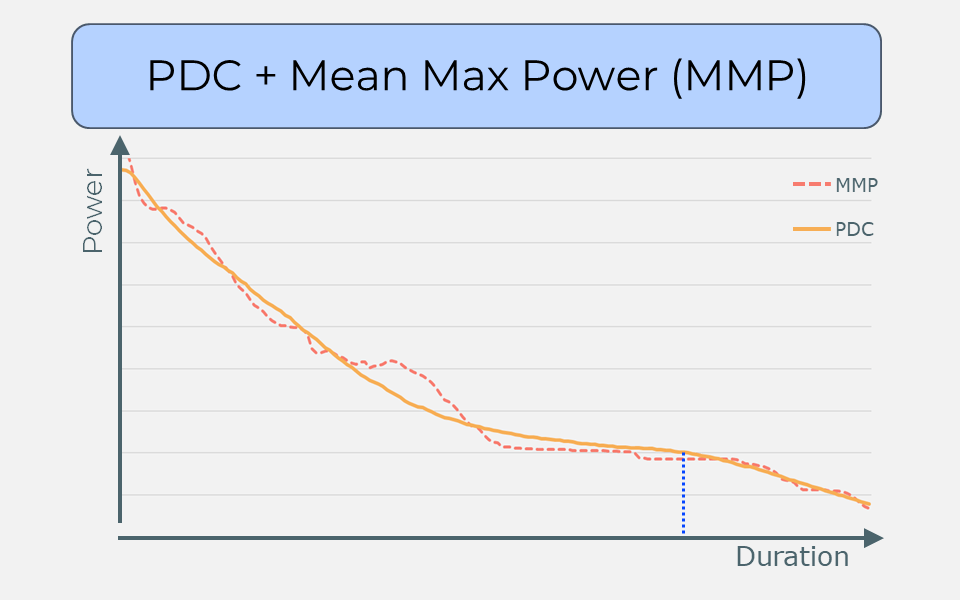
The picture shows the fast element of fatigue as the left side of your Power-Duration Curve, starting from the power axis and extending to the dotted blue line.
Why is this useful?
Knowing the maximum amount of work you can perform and the event distance, you can calculate a race power target for a shorter event (e.g. a 5k), where the fast component dominates.
A race power target that reflects your personal best!
For more information on the research, please see:
🔹 Monod, H. & Scherrer, J., (2007) The Work Capacity of a Synergic Muscle Group
🔹 Hill, D., (2012) The Critical Power Concept
Topic: Power-Duration Curve
⏩ You fatigue faster at higher intensities