

You fatigue more slowly at lower intensities
Intuitively, this is obvious.
If you run easy, you can run for a longer time, and the easier you run, the longer you can keep running (within your personal limits).
What’s not obvious is that there is a mathematical relationship between your intensity (your effort) and how long you can maintain it.
The research
In 1977, Peter Riegel researched the relationship between runners’ performances over different distances and concluded that an exponential curve could predict race times for runners, given a performance at another distance.
The slow component of fatigue follows an exponential curve.
Riegel expanded on his thesis in 1981, stating that his formula concerned ‘activities in the endurance range, lasting between 3-5 and 230 minutes.’
Riegel’s formula plots time versus distance. Work by Van Dijk and Van Megen in 2017 concluded that there’s a similar relationship between power and time.
The curve is always exponential but may be flatter, showing better fatigue resistance, or steeper, showing worse fatigue resistance for longer events.
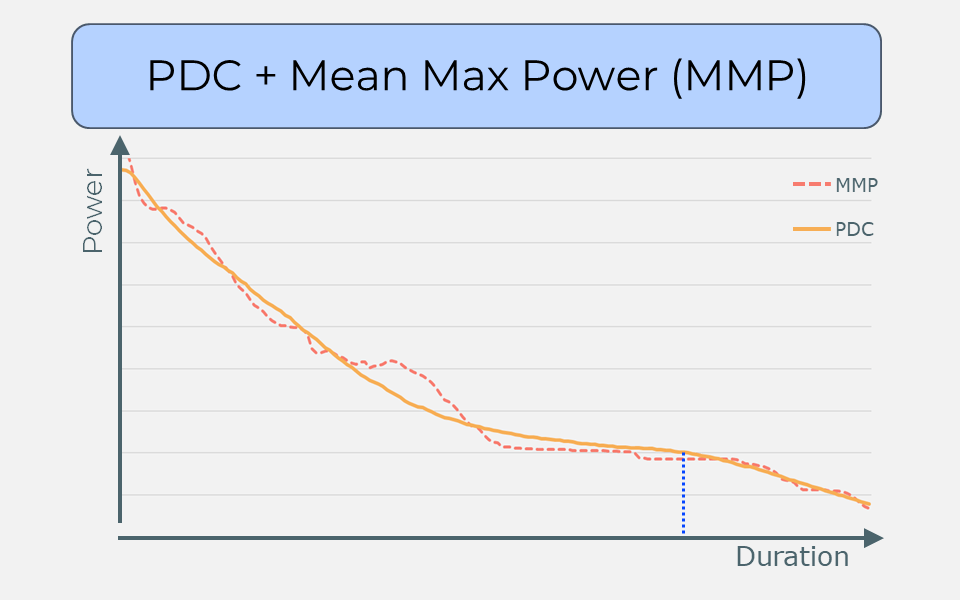
The picture shows the slow element of fatigue as the right side of your Power-Duration Curve, starting from the dotted blue line and extending down and to the right.
Why is this useful?
Knowing the slope of your curve and the event distance, it’s possible to predict how well you might perform for a longer event (e.g. a Half-Marathon), where the slow component dominates.
A race power target that reflects your personal best!
For more information on the research, please see:
🔹 Riegel, P., (1981) Athletic Records and Human Endurance: A time vs. distance equation describing world-record performances may be used to compare the relative endurance capabilities of various groups of people
🔹 Van Dijk, H. & Van Megen, R. (2017) The Secret of Running. Maidenhead: Meyer & Meyer Sport (UK) Ltd
Topic: Power-Duration Curve
⏩ You fatigue faster at higher intensities