
What

Posts that focus on concepts & definitions – the WHAT of running

  • How do I use my PDC?

    How do I use my PDC? Your PDC is individual to you, your fitness, and your abilities. It changes as you train (or detrain). If youโ€™re training for an event, it should move up (higher power for same duration), to the right (longer duration for same power), or both. As long as your PDC is accurate (an up-to-date reflection of your capability), you can use it to: identify the power you should be able to maintain for every duration modelled on your PDC; estimate how well you might perform for a shorter event; estimate how well you might perform for a longer event. How do you know if your PDC is accurate? A good question, and one that deserves a separate post.

  • You fatigue more slowly at lower intensities

    You fatigue faster at higher intensities. Intuitively, this is obvious. If you sprint, you canโ€™t sprint for a long time, and the faster you run, the shorter the time you can keep it going. Whatโ€™s not obvious is that there is a mathematical (hyperbolic) relationship between your intensity (your effort) and how long you can maintain it. This relationship makes it possible to identify an exercise intensity that could be sustained for a very long time (your Critical Power) and the maximum amount of work that can be performed in a given time, both of which can be used to identify a race power target for shorter durations.

  • You fatigue faster at higher intensities

    You fatigue faster at higher intensities. Intuitively, this is obvious. If you sprint, you canโ€™t sprint for a long time, and the faster you run, the shorter the time you can keep it going. Whatโ€™s not obvious is that there is a mathematical (hyperbolic) relationship between your intensity (your effort) and how long you can maintain it. This relationship makes it possible to identify an exercise intensity that could be sustained for a very long time (your Critical Power) and the maximum amount of work that can be performed in a given time, both of which can be used to identify a race power target for shorter durations.

  • What is your PDC?

    What is your PDC? The higher your power (your effort), the shorter the duration you can sustain it; the lower your power, the longer you can sustain it. Thereโ€™s an inverse relationship between power and duration. You can chart this relationship. The result is a chart showing your Mean-Max Power (MMP) โ€“ the best effort you can sustain for each duration (measured using average power for each). Based on your MMP, your PDC models your best efforts over a range of different durations, showing (for each) the effort you could sustain.

  • What’s the best way to calculate threshold power?

    What’s the best way to calculate threshold power? You can use any of the three most commonly used models. Why? Your threshold is a โ€˜phase transitionโ€™ over a narrow range of intensities, with lots of metabolic changes occurring at different rates and in parallel. And your Threshold Power is an intensity thatโ€™s within (or close to) the phase transition. In this context, any of the three most commonly used models can produce a usable Threshold Power. So which should you use? The answer typically depends on the app youโ€™re using to review your power metrics: (1) Using WKO? Youโ€™ll most likely use auto-calculated FTP; (2) Using Stryd PowerCenter? Youโ€™ll most likely use Auto-CP; and, (3) Using another app? Youโ€™ll most likely use Critical Power tests.

  • Is threshold power better than VO2max?

    Is Threshold Power better than VO2max? VO2max is a measure of your bodyโ€™s maximum aerobic capacity – the highest amount of oxygen your body can use during hard exercise. Threshold power is the highest intensity (effort) you can maintain without rapidly fatiguing and needing to slow down or stop. Think of VO2max as โ€˜the size of your engineโ€™ and Threshold Power as โ€˜your highest cruising speed’. A bigger VO2max means you could go further and faster, but it doesn’t mean you’ll use that capacity effectively; a higher cruising speed means you can run harder for a longer period of time. Both are important, but of the two, threshold power responds more easily to training, and is a more direct and practical predictor of performance in endurance events from 5k up through the marathon.

  • How do I use threshold power?

    How do I use threshold power? Your threshold power is an important measure of your running fitness. It’s used to: (1) set training targets – as a percentage of your threshold power; (2) monitor training load – by calculating training load scores (relative to your threshold) for every workout; and, (3) set race/event targets – as your finish time will depend to a large extent on your running fitness (your threshold power).

  • How do I find my threshold power?

    How do I find my threshold power? You can find your Threshold Power using specific models and test protocols. The three most commonly used models are a Critical Power test (CP), modelled Functional Threshold Power (FTP) and Automatically calculated Critical Power (Auto-CP). The models differ but are similar in their approach and purpose โ€“ they: (1) use the results from two or more maximum effort runs at differing durations; (2) identify a power level thatโ€™s close to (or within) your threshold; and, (3) do not rely on lab tests – instead, they are field-based.

  • What is Threshold Power?

    What is Threshold power? At lower intensity levels, your body achieves a metabolic steady(ish) state and you can sustain your effort for an extended period. Researchers call these domains โ€˜moderate to heavy.โ€™ At higher intensity levels, you canโ€™t achieve a metabolic steady(ish) state. Youโ€™ll fatigue much more rapidly and need to slow down or stop. Researchers call these โ€˜severe to extremeโ€™ domains. The change from heavy to severe doesnโ€™t happen at a precise point โ€“ itโ€™s a โ€˜phase transitionโ€™ over a narrow range of intensities, with lots of metabolic changes occurring at different rates and in parallel. Threshold Power is an intensity thatโ€™s within (or close to) the phase transition from heavy to severe – other names for this phase transition include Anaerobic Threshold, LT2, VT2, Critical Power and more.

  • Isn’t power just for elite runners?

    Isn’t power just for elite runners? No – in fact, non-elites may benefit more from power than elite runners, who’ve spent years developing their ‘feel’ for how hard they’re running. Elites can still Run with Power, but non-elites may may get the biggest benefits. As one runner commented, โ€œI honestly think it helps weaker/slower/newer runners even more than experienced fast runners. Itโ€™s like having a coach in a pod!โ€

  • Why does power ‘jump around’?

    Why does power jump around? It’s because your body produces energy stochastically, while your power meter produces a number every second – which can be high, low or somewhere in the middle. Using power averaged over 3 seconds (smoothed power) can remove the ‘spikyness’. When running interval workouts, targets will normally be given for each work interval (each lap), which you can show on your watch as a Lap average.

  • Is power better than pace or heart rate?

    Is power better than pace or heart rate? Power solves issues associated with other measures of running intensity. There are a few things that are different about running with power. And like any new approach, there are some things that take some getting used to; things that will get easier as power usage spreads and the tools develop. However, after running and coaching with power since 2018, I think itโ€™s already the most effective way to train and race.

  • Power Apps – WKO

    ๐๐จ๐ฐ๐ž๐ซ ๐€๐ฉ๐ฉ๐ฌ โ€“ ๐–๐Š๐Ž The WKO app is an analysis and charting tool that runs under MS Windows or on a Mac and provides a wide range of charts and graphs of your power data. It can calculate and display all the most important metrics โ€ฆ and then some. ๐–๐Š๐Ž ๐Œ๐ž๐ญ๐ซ๐ข๐œ๐ฌ โœ… Threshold Power. WKO…

  • |

    Getting Started – Power=Consistent Progress

    To celebrate the upcoming release of the Spanish version of โ€˜Getting Startedโ€™, Iโ€™m planning to update the cover of the English version too. This text (on the green background) will be on the back cover of the books (in the appropriate language) and in the book blurb on reseller websites. This week, I’m posting about…

  • |

    Getting Started – Power=Productive Training

    To celebrate the upcoming release of the Spanish version of โ€˜Getting Startedโ€™, Iโ€™m planning to update the cover of the English version too. This text (on the green background) will be on the back cover of the books (in the appropriate language) and in the book blurb on reseller websites. This week, I’m posting about…

  • |

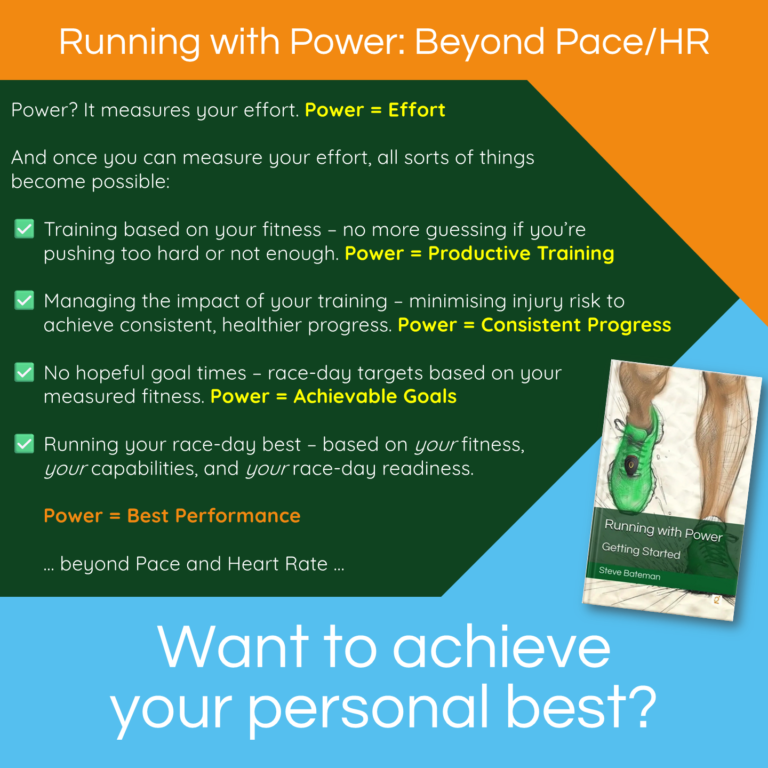
    Getting Started – Power=Effort

    To celebrate the release of the Spanish version of ‘Getting Started’, I’m planning to update the cover of the English version too. The text above (on the green background) will be on the back cover of the books (in the appropriate language) and in the book blurb on reseller websites. ๐๐จ๐ฐ๐ž๐ซ = ๐„๐Ÿ๐Ÿ๐จ๐ซ๐ญ Power measures…